|
Heliospheric Weather Expert Service Centre - Archive Plot Browser |
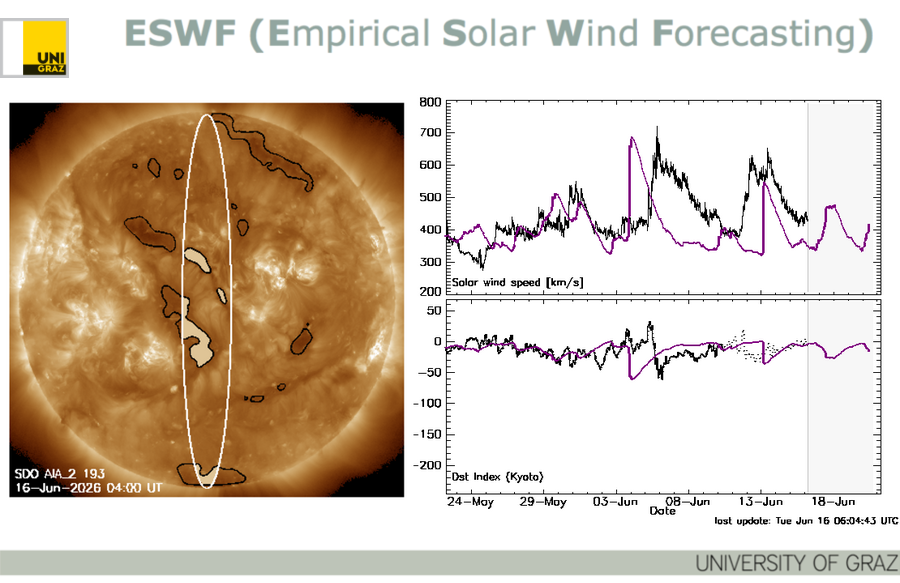
The ESWF uses an empirical relation to derive the solar wind speed at Earth distance (Vrsnak, Temmer, Veronig, 2007). The Sun is monitored in EUV (NASA/SDO) from which coronal hole areas are extracted to calculate the solar wind speed at 1AU with a lead time of about 4 days (Reiss et al., 2016). We compare the forecast to in-situ data (ACE/DSCOVR).
The product went through an update for Portal 3.6 (9th March 2023). Prior to this the product presented the SDO image (left) and the forecast for three different time ranges (right). From Portal 3.6 (ESWFv3.2 onwards) the product consists SDO/AIA EUV images (left) as a basis to predict the solar wind speed at Earth (right top panel) and the Dst index (right bottom panel), both with an average time lag of approximately four days (magenta shaded area). The forecasted solar wind speed profile is compared to ACE/DSCOVR real-time in-situ measurements and the Dst index with quicklook Kyoto Dst data (dashed profile) as well as with the final Dst data (solid line). From ESWFv3.2 onwards the product utilises a dynamic thresholding for CH extraction, the co-latitude information for the center of mass of the extracted CH, a newly developed algorithm for better simulating the compression region between slow and fast solar wind (PILE algorithm), and the Dst index forecast based on the CH underlying magnetic field from SDO/HMI data. A more detailed product description and references can be found on the main product federated page using the link below.
This service is updated automatically every hour.
The H-ESC archive provides snapshots taken every hour. Please visit the ESWF web page for detailed product descriptions and the latest forecast ESWF