
|
Heliospheric Weather Expert Service Centre - Product Browser |
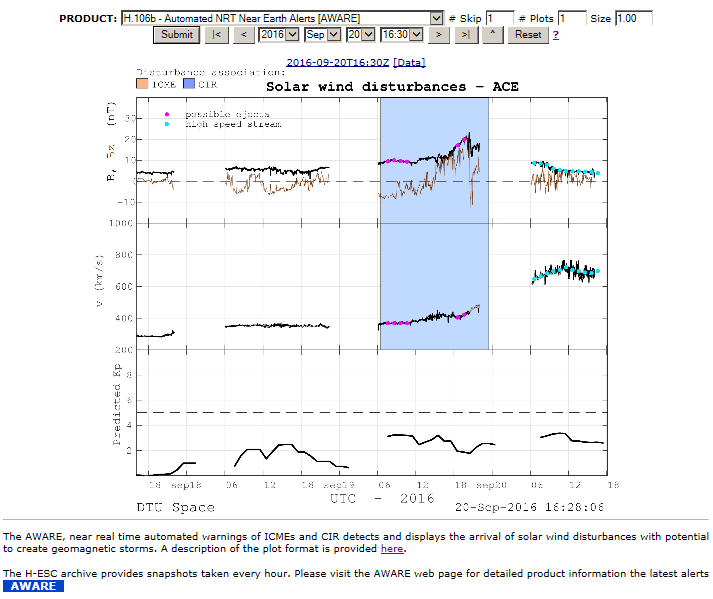
The service for Automated WARnings of Earth arrivals (AWARE) detects and displays arrival of solar wind disturbances with a potential to create geomagnetic storms. The arrivals are displayed on top of the near real-time solar wind time series observed in L1 by the ACE spacecraft, and kindly made available by NASA and NOAA. The top curve shows the interplanetary magnetic field, with the total intensity in black and the Bz-component in brown. The middle curve shows the solar wind speed v. These parameters are well known to be the most important for the geo-effectiveness of the storms.
Significant interplanetary shocks are displayed as red vertical lines. Time intervals of solar wind disturbance are marked with background shading. Disturbances due to solar eruptions, i.e. Coronal Mass Ejections (CMEs), classified as Interplanetary Coronal Mass Ejections (ICMEs) are marked with the orange color shown at the top of the display. Disturbances created at the front edge of high-speed streams as they interact with the surrounding solar wind, i.e. classified as Co-rotating Interaction Regions or just Stream Interaction Regions (CIRs/SIRs), are marked with the blue background shading.
Disturbances where the classification is more uncertain are displayed in lighter orange and blue colors. If the disturbance cannot be automatically classified, it is displayed in grey.
Independently of the classification of disturbed intervals (background markings) each hour of solar wind observations are analyzed separately to determine the most likely solar origin of that material (Xu and Borovsky, 2015). If it is possible CME-ejecta it is marked with a pink dot, and if it is high-speed stream material from a coronal hole it is marked with a light-blue dot.
The bottom curve shows a prediction of geomagnetic activity Kp based on the last 3 hours of solar wind observations. When the predicted Kp reaches storm levels (i.e. Kp.5) it is displayed with a red marking.
The currently supplied data file (accessed from the link next to the time above each plot) list of arrived shocks and disturbances.
The file is in fixed format ASCII
| Parameter | Description |
|---|---|
| Column 1 | Date/Time of the event (ISO8601 calendar segmented format) |
| Column 2 | The type of disturbance (CME, CIR, IP_Shock or NoID) if displayed in lower case the classification is more uncertain. |
| Column 3 | Indicates if the alert corresponds to the "start" or "end" of the disturbance (IP_Shock will only have "start" status) |